Like movies, books too can become ‘cult classics.’ Zen and the Art of Motorcycle Maintenance (bookshop.org) is one of those books. Written by Robert Pirsig after a cross-country motorcycle trip with his young son, provided the narrative in this story.
The book is about traveling, yes. But also, about people, time, ideas, and most of all, trying to define ‘quality.’ Merriam-Webster defines the term as a ‘peculiar and essential character.’ What is it that is so peculiar about it?
The story is not one of a simple road trip. Pirsig beautifully describes the scenery on the open road, detailed descriptions of overnight stays at roadside camp sites and recalls seemingly innocuous, yet profound, moments between a father struggling to explain himself to his young son. “Are we there yet?” “I want to go home.”
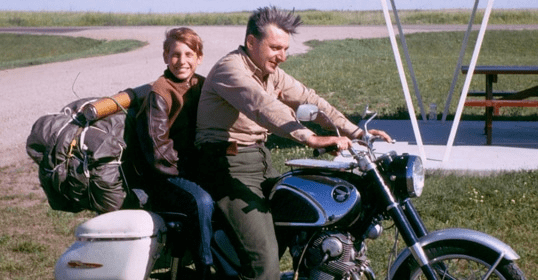
Pirsig’s motorcycle, diligently cared for along the journey in a meditative retelling, serves to further the author’s reflections on ‘quality.’ The way he breaks the machine down, not just to its parts, but the physical properties of the metal itself will make it hard to look at a motorcycle the same way again. If you’ve ever been frustrated by a stripped screw head, this book is for you.
If the dictionary can define the word in four words, then why does it take Pirsig over 400 pages to prove his thesis? It’s not because the pages include detailed descriptions of motorcycle maintenance. Rather, to define the word, the author must first contend with Phaedrus, a mysterious character that Pirsig develops throughout the book. Defining ‘quality’ consumes Phaedrus.
In a powerful moment on the side of the road, Pirsig and his son finally meet on the same level. The scene is beautiful not just for the vivid description of the California seaside, but for the clarity with which Pirsig fully opens himself not just to his son, but to the reader. In finally understanding the source of a recurring bad dream, Pirsig says to his son, “I couldn’t open that door. They told me not to open it. I had to do everything they said.” These words also confirm for the reader that Pirsig is Phaedrus, and the doors in his dream are from the psychiatric hospital where he received aggressive treatment for depression. The weight behind the revelation serves as a fitting climax for the trip. Father and son then head inland and south through Mendocino County on Route 101. Pirsig’s description almost allows you to smell the famous redwood.
When I was diagnosed with squamous cell carcinoma in 2023, ‘quality’ took on a different meaning for me.
In the investment world, ‘quality’ can refer to any number of statistical measures to figure out the ‘goodness’ of a business. Frequently however, investors using the factor will have different, and sometimes unrelated, statistics that define it.
My cancer diagnosis didn’t change who I was, but it did change the way I thought about ‘quality.’ Like Pirsig, I spent a lot of time in a hospital.
Cancer not only gave me the courage to keep asking progressively harder questions, but the ability to get comfortable being uncomfortable with the answers.
Cancer forced me to slow down. To stop, really. It stripped away the distractions that had once ruled my sense of time – work deadlines, commuting routines, career ambitions – and replaced them with something more fundamental: endurance. The hours passed slowly, filled with discomfort that no amount of willpower could ignore. By breaking each hour down to increasingly smaller increments, I could enjoy small victories while waiting for a safe time to take another dose of medication.
When you can’t escape pain, you have no choice but to study it deeply. I found myself questioning everything, not just about my health, but about reality itself. What was happening inside me at a cellular level? What decisions, what exposures, what inputs had led to this moment? What was fair? What was random? How was it random? What really matters?
Like Pirsig methodically disassembling his motorcycle to build it back, I wanted to break down the complex system that had led to this moment, to break it down to its raw components, to find the fault in the logic, to understand. But the deeper I looked, the more I realized how narrow my original framework was. I had spent years studying and analyzing markets, looking for explanatory patterns. Correlation chasing causality. But here I was, encountering something that crushed my pursuit of efficiency. The combination of increasingly smaller increments of time and a wider appreciation for what matters led to a new framework. Something chaotic and grand that no equation could fully explain.
My journey was different from Pirsig’s, just as yours will be different from mine. We don’t all take the same paths through the wilderness of life, but there are things shared among us along the way.
Like it or not, nobody ever goes it alone. We are all shaped by something, by what we’ve experienced, seen, heard, or read. Nobody pulls themselves up by their bootstraps. We’re all born without shoes.
Life is hard. But, if you’re willing to face vulnerability with the courage to be unafraid, the layers of difficulty can peel away.
We are never alone in our journeys. Through space and time, we are all linked together. This isn’t a hippy pie-in-the-sky metaphysical metaphor either; it’s a scientific fact. Sometimes, people discover this in unconventional ways, perhaps best described by Oglala Lakota medicine man Heȟáka Sápa, Nicholas Black Elk, when he spoke to poet John Neihardt:
“And while I stood there I saw more than I can tell and understood more than I saw; for I was seeing in a sacred manner the shapes of all things in the spirit, and the shape of all shapes as they must live together like one being. And I saw that the sacred hoop of my people was one of many hoops that made one circle, wide as daylight and as starlight, and in the center grew one mighty flowering tree to shelter all the children of one mother and one father. And I saw that it was holy.”
After the revelation on the side of the road, Pirsig makes a similarly profound statement. In case the reader missed some of the details along the way, he narrates the death of Phaedrus:
“This is the last time I will see them. I am Phaedrus, that is who I am, and they are going to destroy me for speaking the Truth.”
And so, as we move forward, remember this ‘Truth’: we are all part of something greater, and the search for ‘quality’ is not a solitary or fixed one.
 The Cultural Easton