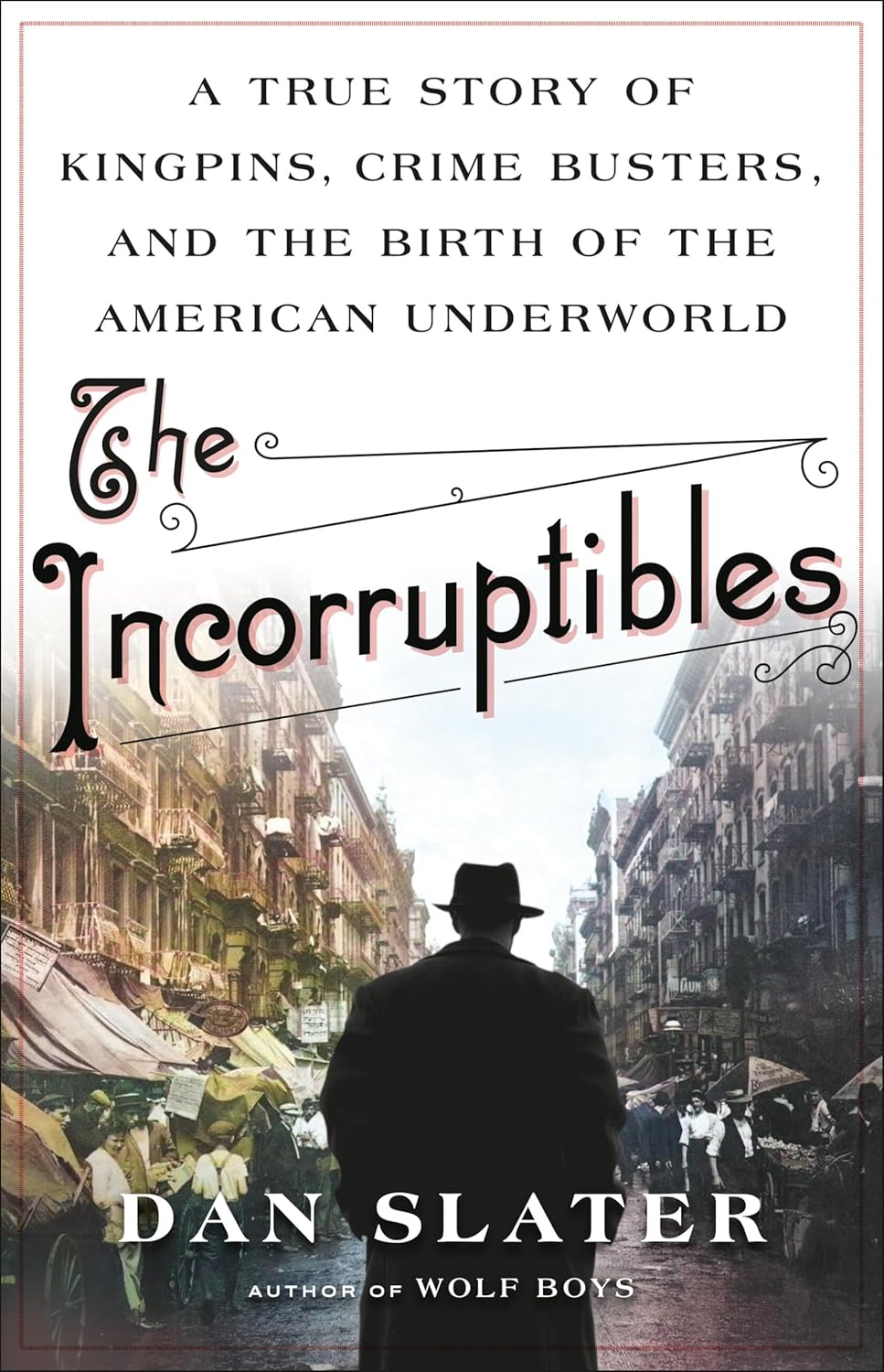
The air in the Lower East Side of Manhattan reeks of garbage and the decaying stench of dead horses left to rot in the street. Shoeless children, their clothes dirty and tattered, gamble openly and pickpocket what they can to survive.
Across the corner, children climb and jump off the cold body of a poisoned horse, a recent victim of the Yiddish Black Hand. Sweatshops hum away, Eastern European Jewish immigrant workers crammed, and sometimes locked, in deplorable conditions. The police, meant to protect law and order, are loyal only to their own pockets and the political machine of Tammany Hall.
This is the world of Easton author Dan Slater’s, ‘The Incorruptibles,’ a vivid retelling of how poverty, vice, wealth, and reform efforts clashed in a city teetering on the brink of chaos.
The immigrant experience in early 20th century New York City, is often idealized by references to Ellis Island and the Statue of Liberty. While Lady Liberty may have welcomed Eastern European Jews fleeing the Pale of Settlement, the conditions on the ground in inside the city proved to be a constant struggle for survival, let alone a decent life. Slater retells the horrific experience of a young women, exploited at a garment factory with terrible working conditions and preyed upon by underworld pimps.
A garment girl had to be weary of male suitors, with wily predators going so far as to marry a girl only to then trick her into prostitution before moving on to his next victim. For these girls, family values at the time meant the awful experience left them little choice but to continue in the oldest profession, their fathers turning them away for what had been done to them.
Slater brings the streets of Manhattan to life, his extensive research evident in the mundane details that one remembers when faced with a shocking trauma. In one telling, Big Jack Zelig, a prominent figure in the underworld, goes from fighting Italian mobsters to his usual table at Siegel’s Café, where he has a run in with a lowly pimp named ‘Red’ Phil Davidson. Zelig smacked the pimp across the face, blackening his eyes.
Red Phil then left, but this being Siegel’s, which Slater describes as a “hangout for thieves,” Zelig did not. He stayed and drank his regular, a seltzer with lemon, and dealt a hand of solitaire. While playing, Big Jack decides to rat out the “bag man” of one of the largest gambling operations in the city, Dollar John Langer’s. He dispatches a messenger with a bathhouse ticket scrawled with a name, then Red Phil returns asking to make amends, to which Zelig agrees, paying the black-eyed pimp $5 for his troubles.
Zelig then heads to the barber for a shave and hops on a trolley. It’s here where Slater’s storytelling shines, as Big Jack meets his maker from the perspective of a young boy on the trolley. After lighting his cigarette, Zelig smiled at the boy and his mother. In describing what happens next, Slater writes, “He didn’t notice when the motorman turned around and addressed a crazed-looking character behind Zelig. ‘What’s the matter?’ asked the motorman, moments before Red Phil aimed his gun and pulled the trigger.” For the second time in just four months, Big Jack was shot in the head, this time fatally so. The scene is jarring and clearly remained burned in the memory of the young man for the rest of his life.
In the following scene, reformer and occasional vigilante Abe Shoenfeld opens Big Jack’s note. The ticket inside bore the name ‘Inspector Cornelius Cahalane,’ and in the following week, one of the Inspector’s Lieutenants is caught in the act, picking up a bag of money from the Prince George Hotel. Abe and fellow reformer Rabbi Judah Magnes are with the mayor as the corruption is exposed.
Mayor William Gaynor is impressed by Abe’s ability to navigate the underworld and his moral conviction. Not all reformers were like that, the book includes a humorous account of a police commissioner getting sloshed after legal drinking hours at a saloon and then proceeding to the police station to drunkenly berate the officers for allowing him to do so.
The mayor asks the Rabbi and Abe to bring him useful information about derelict behavior. Granting Abe’s wish to remain anonymous, Gaynor translates his name, saying “I know only a Mister Prettyfield.” With that alias, Abe Schoenfield would go on a remarkable run of reform campaigns, targeting horse poisoners, gambling operations, and whorehouses, and forever changing American policing in the process. Some of his tactics were illegal, but to be fair, sometimes good people need to break the law when it is being used to illegal ends. The corruption of Tammany Hall was spectacular. It’s hard to shut down prostitution for example, when the entire system is providing ample cash flow to pimps who then kick it back to the bosses. With vice laws being new, there were no established procedures for Abe to follow, all he had was his moral compass.
Unlike Big Jack Zelig, Abe survived the ‘Roaring Twenties,’ and then went on to combat anti-Semitic organizations and people. The book is well sourced, and Slater’s lively retelling of a chaotic period in American history provides timely insights.
The book has two photographic sections, the black and white photographs depicting scenes that almost appear cartoonish by today’s standards. For example, an image of a couple of young pickpockets being escorted by police to an amusingly small, horse-drawn paddy wagon is almost comical. Recently,
Dan hosted a talk at the Easton Public Library on Sunday, March 2nd, where he discussed his work and showed more of the pictures he had acquired during his research process. From glamorous nightlife scenes to grim murder scenes, the photos offer an interesting look at an oft-forgotten period.
But Slater’s book doesn’t just capture a forgotten era, it exposes the long cycles of corruption, vice, and reform that still impact American society. From pickpockets and horse poisoners to modern-day scam artists, fraudsters and crypto schemes, ‘The Incorruptibles’ is a fun read that reminds us of how much and how little has changed.
Native New Yorkers will recognize the streets and neighborhoods of the city that still bear whispers of their tumultuous past. History buffs, particularly those interested in policing, immigration, or organized crime, will appreciate Slater’s deep research and compelling storytelling. With a robust notes section, the book strikes a good balance between academic depth and broader accessibility.
 The Cultural Easton