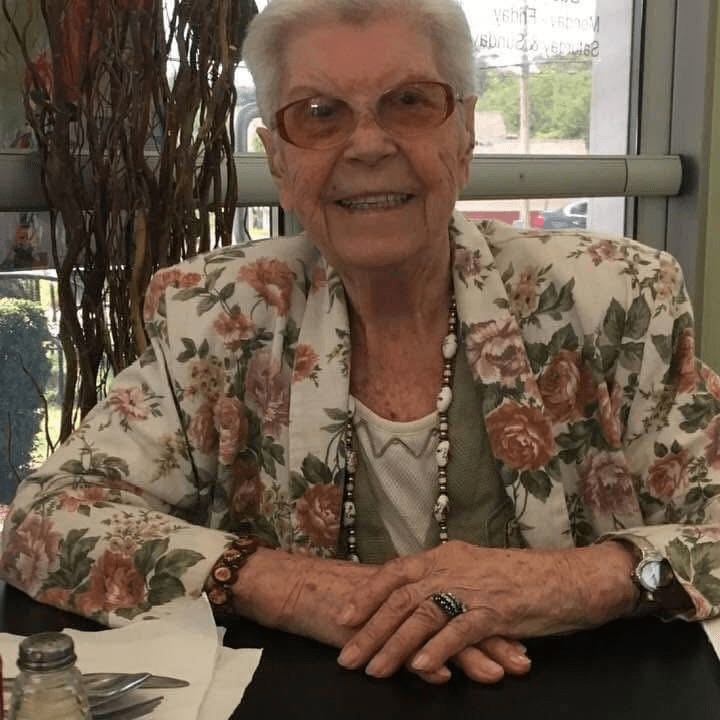
My mom is my hero. Not just because she is my mom, but because of how many obstacles she overcame to create our family.
As I reached each phase of womanhood, I did it by emulating her incredible strength and character. She created a roadmap for her children through her story. I found my own identity as a result.
I’m not sure of the exact timeline of the adversity she underwent, growing up in the thirties and forties as an orphan in Greece. I could only listen to these stories while sipping a bowl of her avgolemono or lentil soup, or eating a freshly baked piece of spanakopita or baklava.
In fact, there was always storytelling involved with cooking, baking and eating. I realize now that she wanted to let us know the details of who she was and where she came from and would only do so with the presence of something positive to balance the negative.
She was born, Theofanula (Light of God) Manthu, to Efthimia and Athanase Manthu, in Katerini, a village in northern Greece, at the base of Mount Olympus, the magical place of the Gods.
And for anyone who has been to Mount Olympus, the presence of the Gods and Goddesses on the trails, while hiking up to the top, is lined with statues around every corner, to remind humans that they are merely sharing this planet with higher entities. It is one of the most magical places on earth, and my mother is a product of that magical place.
At the tender age of five, her mother died of a stroke in the middle of the night, as a result of toxemia. Anytime she spoke of her mother, she would struggle to remember the details of the story. We could tell she was filling in parts of her memories of her mother that were a void, not only in her mind, but also in her heart. The tidbits she shared with us of her mother would change slightly each time she told them. Then she’d smile. Sometimes she would cry.
After her mother died, she lived with her father, of whom she had more vivid memories. Two short years later, when my mom was seven, her father was killed at war. Her father had remarried the year before, so my mother was raised for a short while by her stepmom, until her stepmom, who had to also raise my mom’s half brother, couldn’t afford to support both children. My mom went to live with another relative, Anastasia, whom she considered her second mother.
Throughout these years of familial transition, her village had more often than not, been invaded and occupied by the German and Turkish armies. Her school was bombed when she was in seventh grade, and she could not continue her education.
School was a place where my mother found security as an orphan with her teachers as role models. Losing the opportunity to receive an education was just another way of the universe placing an obstacle in her way.
When she turned 15, she went to work as a seamstress and began to support herself. I loved looking at the pictures of her walking around town with her girlfriends. Her outfits were so beautifully tailored to her petite stature. She was by far one of the best dressed women in town. She always looked like she stepped right out of an Ann Taylor catalogue.
Although she was always smiling in those pictures, when walking around in her hometown with her girlfriends, she told us that when she put her head down on the pillow each night, she could hear the bombs and land mines setting off in the distance.
On one occasion, she and her cousins hid their Jewish neighbors underneath the floorboards of their home, while German officers would come in her house in the middle of the night. Every time she told this story, I’d get chills, as she would become consumed in fear as she relived the idea that if the German soldiers found out, they would shoot everyone in the house.
When we asked why her family took that chance, she said, ” We had to. What were we going to do? Let our neighbors die? ” The Greek idea of Philoxenia, love for strangers, was fully engrained in her village and her being, a belief she carried throughout her life.
When she was nineteen, she was walking home in one of her beautifully sewn outfits, and as fate would have it, she strolled right by my father. My father was born and raised in Rhode Island and decided to take a trip to Greece to visit relatives when he finished his service in the US Air Force. My mother stood out to my father, the same way she stood out to me in those photos, and he claims that he fell in love with her at first sight.
My mother was not allowed to date, however, since it was still a time of arranged marriages in Greece, which brought all attempts of courtship on my father’s part to a screeching halt.
They had to go on chaperoned dates with my mom’s cousins, who were farmers and butchers, pacing 10 feet behind them at all times with large knives strapped to their belts. My father claims that every time he turned around, they would all laugh.
My mom and dad married in Greece, and after a six month honeymoon in Europe, which began by boarding the Orient Express in Istanbul and ended in Paris, they came back to live in the US. My mother, being a good wife, patiently followed alongside some of my dad’s dreams, and they moved to Manhattan and started their own business.
My dad’s parents owned a successful bakery in Woonsocket, Rhode Island, and my dad always wanted to open his own bakery in New York City. They lived in Manhattan with my two sisters for several years. I loved listening to how she’d take my sisters via stroller in the 1950’s up to Central Park or shopping at Macy’s.
Then one day, my mother (the practical one), told my father that she wanted to buy a house in the country. So they bought a house in Connecticut where both my brother and I were born.
Eventually, they built a larger house in Fairfield, to fit all of us. Our childhoods’ did not resemble my mother’s childhood in the least bit, and we would listen to her stories in awe, as they yielded us an appreciation for where we came from and for all that we had, which was her intent.
Although she did not have to, my mother sewed all of our dresses and coats. She would crochet and knit our sweaters, hats and gloves. She made home made meals, bread and baked goods every night, and boil a large pot of Greek mountain tea and placed in glass carafes and kept in the fridge.
She rarely allowed us to eat junk food. We were allowed one gallon of ice cream a week, for all four children to share (which my dad would eat most of) and a package of store bought cookies, either Chips Ahoy or Oreos. She always made homemade Greek cookies and pastries, but buying the store bought cookies was her way of letting us know, it was ok to assimilate.
Otherwise, we ate a Mediterranean diet, which none of us really appreciated at the time, except for my father. We always longed to eat hamburgers, hotdogs and pizza, to fit in with the other kids, and because it tasted good.
Although she became very modernized as an American citizen, she still held onto her self sufficient Greek identify, with which she so strongly identified. However, she never forced her culture, traditions or religious views upon us, but rather, always tried to meet us where we were at. There was a great deal of push and pull, in a comfortable and safe way.
My mom was a true Greek Odyssey, and as I said before, my hero. She passed away, last Monday, July 21.
I can’t tell you how heart broken I am. She was my best friend. But I couldn’t be happier that she was 92, lived an amazing and inspirational life, didn’t suffer, and I was holding her hand when she died.
Love you, mom. Rest in peace with dad and celebrate in your long awaited reunion with your parents. 🙏🏻
 The Cultural Easton