I was recently asked to deliver the inaugural talk for the newly formed School of Climate, Environment, and Society at Clark University. My task was to discuss my journey from global finance to sustainability and creativity, framing it for future leaders of systemic change. That talk has inspired this three-part series of articles. What follows is Part 2.
Headline: Climate Change Isn’t Just Warming. It’s Volatility. Here’s How to Hedge the Biggest Risk of All.
We often picture climate change as a steady, rising line on a graph: global temperature. But the real danger, the one that disrupts civilizations, isn’t the trend line—it’s the violent swings around it. The true crisis is Climate Volatility and understanding this reframes the entire challenge from one of mitigation to one of strategic risk management and resilience.
From Equilibrium to Chaos: Redefining the Problem
My career began on the trading floor of the Chicago Board Options Exchange, a temple to the concepts of equilibrium and volatility. These aren’t just financial terms; they are universal principles governing all systems.
- Equilibrium is a state of balance. In our planetary system, it’s the stable climate patterns that allowed agriculture, cities, and global trade to flourish. It’s the “normal” rainfall farmers could rely on.
- Volatility is a measure of unpredictability—the difference between outcome and expectation. High volatility means rapid, disruptive change. Extreme volatility is chaos.
For millennia, humanity built its civilization on our inherited climate equilibrium. But now, we are forcing the system into a volatile state. A warmer world, physically, is a more energetic and chaotic world. As I state in my talk: “Climate Volatility means more extremes of ALL types.”
This isn’t just theory. Rainfall is becoming bimodal: nothing, or all at once. We see “1-in-1,000-year” storms with terrifying frequency. The Texas power grid freezes under unprecedented cold; Northern Europe bakes under historic heat domes. The problem is the swing, the deviation, the breakdown of predictability. Our infrastructure, agriculture, and economies are built for a world that no longer exists.
The Tools for the Job: Hedging Planetary Risk
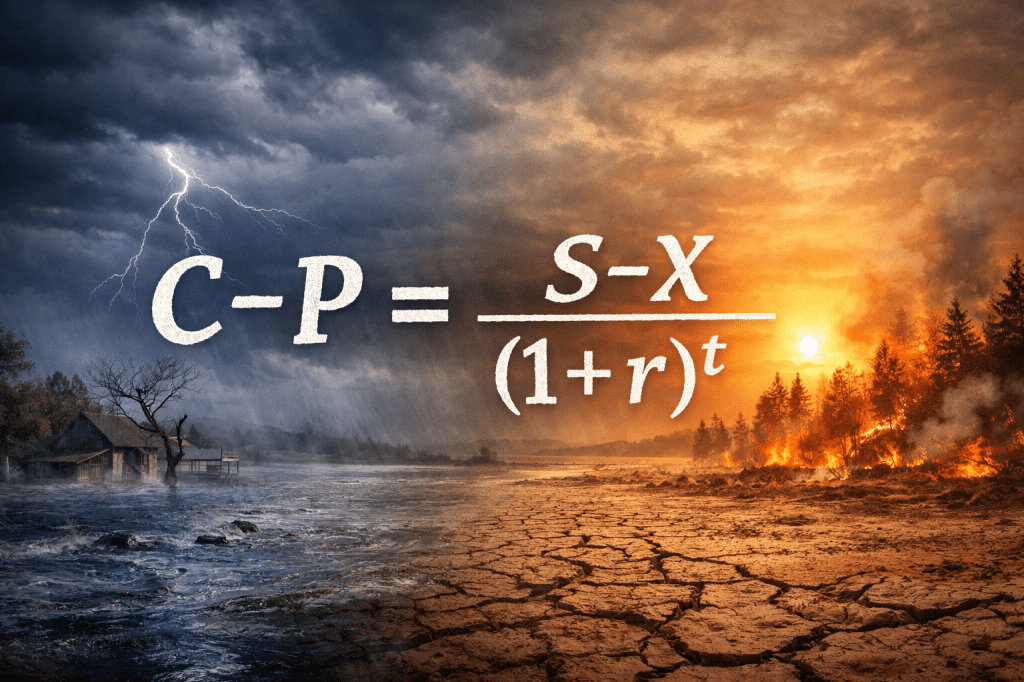
If climate change is a volatility problem, then we already have a powerful toolkit for addressing it—not from environmental science, but from finance and systems engineering. We need to become planetary risk managers.
1. The Put-Call Parity Model for Climate: In finance, put-call parity is a fundamental law that links the present price of an asset to its future price. My adaptation uses this model to compare a sustainable present with an unsustainable future.
The key insight? It reveals a massive, unaccounted-for “risk premium“ embedded in unsustainable choices (like building in floodplains or relying on fossil fuels). Conversely, it shows the hidden value (resilience, stability) in sustainable choices. Most crucially, it includes a decay function showing that the “time value” of inaction is relentlessly negative. The longer we wait to act, the more catastrophic the volatile future becomes, and the more expensive the solution. A prime example is coastal real estate: its value today ignores the near-certain future costs of flooding, storms, and insurance collapse.
2. Changing the Core Algorithm: Our economic system is an algorithm that produces predictable outcomes based on its inputs. A system that doesn’t price carbon will overproduce carbon emissions and comparable pollution. A system that sees labor only as a cost will create inequality. A system that views nature as “free” will deplete it.
Therefore, the highest-leverage intervention is to change the algorithm. The most powerful example is an honest, global price on carbon. Price carbon pollution—and let the market—the same system that delivers smartphones and groceries—efficiently reallocate capital away from fossil fuels and toward innovation.
My proposed design pools that revenue and reinvests it: half in a progressive Universal Basic Income to cushion the transition and build social equity, and half in building shared climate-resilient infrastructure (renewable energy, sustainable agriculture) in communities most vulnerable to volatility. This isn’t pie-in-the-sky; it’s systems engineering. Sweden tested a similar incentive model with speed cameras, pooling fines into a lottery for safe drivers, successfully changing behavior.
3. Mimicking the Master Engineer: Nature Beyond financial models, our single best guide for managing volatility is biology. After 3.8 billion years of evolution, life is the ultimate resilience engineer.
We must shift from fighting nature to integrating with it. I’ve seen a brilliant example: a freshwater aquaculture system that repurposes waste into feed, which then stimulates carbon sequestration in pastureland. Its saltwater cousin uses mangrove rings for coastal restoration and carbon capture. These are circular, regenerative systems that turn volatility (like nutrient runoff or storm surges) into inputs for growth. They don’t just strive for efficiency; they build inherent resilience.
The Leverage Point: Redefining the Cost of Capital
During my time in asset management, I advocated for a fundamental shift: recognizing that the true cost of capital must include the rate of restoration, not just the rate of extraction. If a project destroys a forest or pollutes a watershed, the cost of repairing that damage should be priced into its financing from day one. Set this cost correctly, and the economic algorithm would naturally produce sustainable, resilient outcomes.
This is the core translation for a non-technical audience: We are not helpless in the face of climate volatility. We have a blueprint:
- Reframe the challenge as a risk management problem.
- Apply proven tools from finance (like pricing risk) and design (like circular systems).
- Intervene at the point of highest leverage (like systemic pricing and the cost of capital).
The goal is not to return to a mythical, static past, but to actively build a new equilibrium—one that can withstand the shocks of a more volatile world while regenerating the natural capital we depend on.
This technical and systemic work is essential, but it is not enough. It must be powered by the right mindset and strategy. In Part 3, we will explore the personal framework for action—how to cultivate the resilience and skill to deploy these solutions, especially in the face of the inevitable “No.”
Ken Coulson ken@futurebrightllc.com

