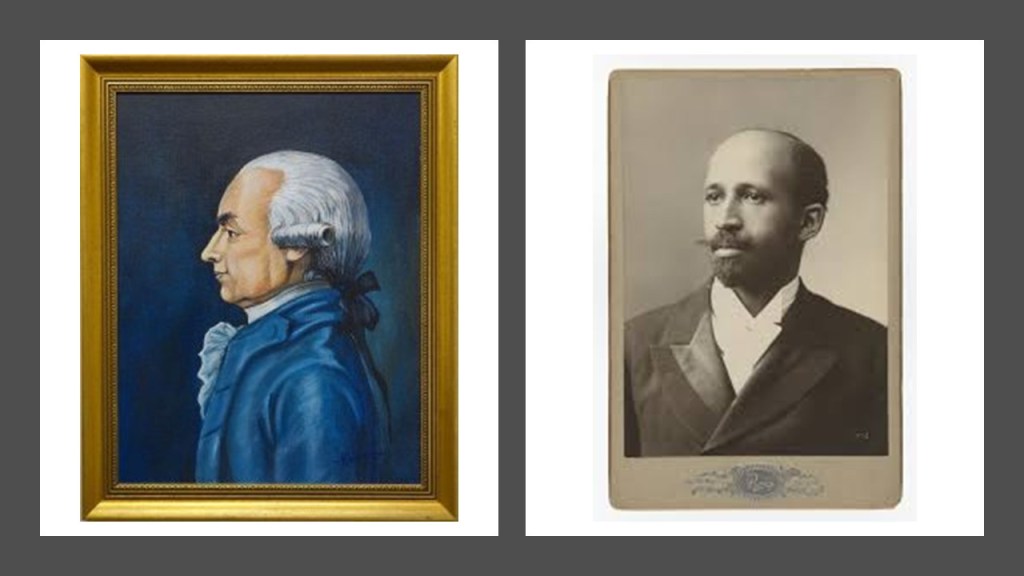
Two authors I teach side-by-side in my American Literature class, who have different, yet similar perspectives on what it means to be an American, are J. Hector St. John de Crevecoeur and W.E.B. Du Bois
In his letter to persuade more settlers to make their way to America, What is an American?written in 1782, J. Hector St. John de Crevecoeur, a migrant farmer from France, describes diverse groups of people coming to America and the new found freedoms they had experienced in this new land.
Europeans, especially the poor, were being oppressed by authoritarian governments. When they came to America, they were able to make a living for themselves and look out for their own interests, creating new ideas and government.
Crévecoeur claims, “We are nothing but what we derive from the air we breathe, the climate we inhabit, the government we obey, the system of religion we profess, and the nature of our employment” (Crévecoeur 313).
Although Crevecoeur’s writings were quite persuasive, they excluded the experiences of the African and Caribbean population brought to America involuntarily as slaves, the very thing Crevecoeur convinced people to flee from, and the experiences of the oppressed indigenous peoples, living here before the settlers.
Many years later, in 1903, W.E.B. Du Bois chronicles the experience of Black Americans living in a post Civil War America in his seminal work, The Souls of Black Folk.
Although Crevecoeur and DuBois were writing in two different historical and cultural contexts, there are differences and similarities in their ideas.
In his letter, Crevecoeur goes into great detail discussing the freedom and opportunity associated with living on the frontier, while Du Bois saw hope for political rights and access to land for Black Americans with the end of the war and slavery.
Both Crevecoeur and Du Bois understood that the idea of being an American offered freedom, hope, and opportunity, but that reaching these goals required a a lengthy dedication and commitment.
As both authors point out, along with many others, America is a continual work in progress, which perhaps has always been the greatest and most vital characteristic of its identity. We must actually preserve and work towards these goals in order to not lose these ideals and freedoms.
Letters from an American Farmer and Du Bois’s Souls of Black Folk.

